The Difference Between Agentria and Claude's Product Suite: Tools vs. Operating Systems
Agentria is an organizational operating system — one that designs business workflows on a visual canvas, accumulates reusable assets, and handles deployment and governance at scale. Agentria for organizational processes.

Agentria and Claude's Product Suite: Tools vs. Operating Systems
A question we hear often from organizations evaluating Agentria: "How is it different from Claude?" It's a fair question. Anthropic has moved fast in 2026 — Claude Code Routines, Claude Cowork, Claude Security — each one claiming to be an "agent." But to answer it properly, you have to look past the feature list. The real question is which layer each product operates on: is it a tool for an individual, or an operating system for an organization?
The difference between a tool and an operating system — like Excel vs. ERP
One person being good at Excel is a different problem from a company running on ERP. Every Claude product operates within a single person's working context. Claude Code runs inside a CLI session. Cowork runs on a personal desktop. Claude.ai runs inside a personal conversation. Agentria is an operating system — one that designs agentic workflows at an organizational level, accumulates them as reusable assets, and handles deployment and governance across API and MCP. This is why Genesis Lab calls Agentria an Agent OS.
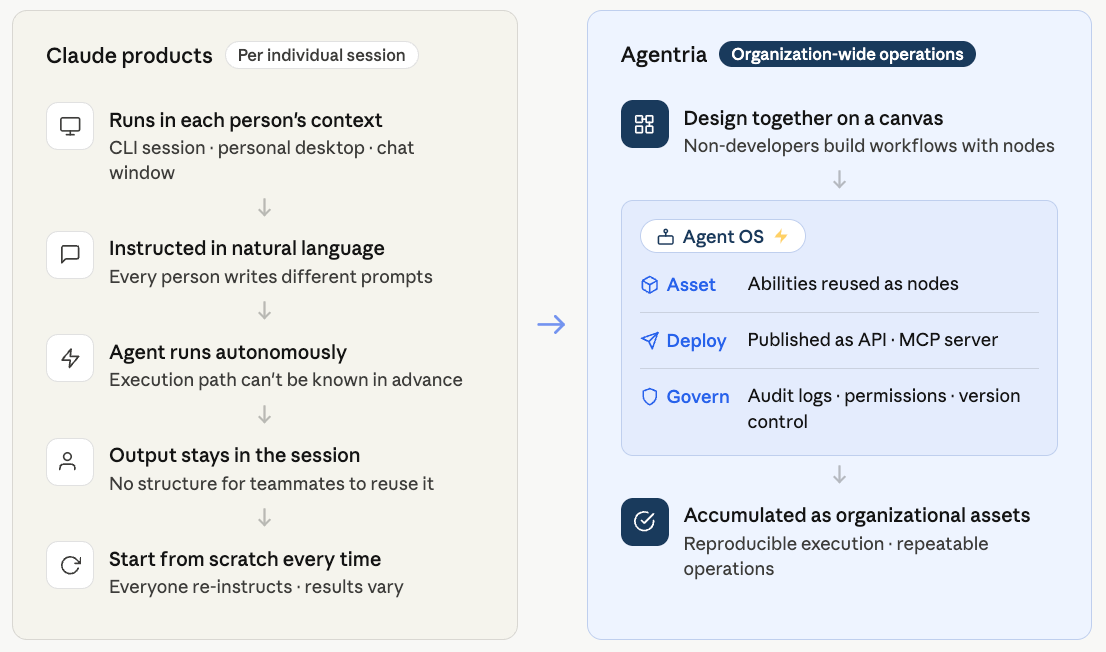
So the answer to the original question isn't "which one is better" — it's "do you need a tool for individuals, or an operating system for your organization?" The five products below explain why.
The five Claude products and what they do
Claude (claude.ai) A conversational AI assistant. It handles individual tasks — document drafting, code analysis, research, summarization — through natural language. The Projects feature preserves context across sessions, giving individuals a repeatable starting point for recurring work.
Claude Code and Routines A CLI- and IDE-based coding agent built for software engineers. Routines, released as a research preview in April 2026, is the scheduled execution extension of Claude Code. It runs periodic code reviews, PR checks, and CI failure analysis on Anthropic's cloud — so it keeps running even when your local machine is off. Execution limits vary by plan: 5 runs/day on Pro, 15 on Max, 25 on Team and Enterprise.
Claude Cowork Claude Code's agentic architecture wrapped in a desktop app for non-developers. Point it at a folder, describe what you need, and it handles multi-step tasks: reading, writing, and organizing files. Scheduled Tasks supports recurring work, but execution is local — if the app is closed, scheduled tasks are skipped.
Claude Security A specialized product that scans codebases for vulnerabilities, explains severity and reproducibility, and suggests patches. Launched as a public beta for Enterprise customers in late April 2026; Team and Max plan support is planned.
Claude Console The management dashboard for teams building on the Anthropic API. It covers API key management, usage monitoring, and prompt testing, and now includes the Managed Agents beta for agent execution infrastructure. It does not handle visual workflow design or the accumulation of those workflows as organizational assets.
So what should Agentria actually be compared to?
When Claude Code Routines launched, communities like Reddit debated whether it would replace workflow automation tools like n8n. That's half right. Routines is a scheduled execution feature for a coding agent — it connects to external tools like Slack via MCP, but its core is an agent model where the LLM drives execution through its own reasoning. That's a different design intent from a workflow builder where you lay out logic as a node graph.
This is why one-to-one feature comparisons between individual products don't quite hold. Even Console's Managed Agents — the closest analog — provides agent execution infrastructure, but stops short of the structure needed to design, operate, and govern workflows at an organizational level. The current focus of Claude's product suite is personal productivity and developer productivity. Building automation into organizational assets, deploying it, and controlling it at scale remains outside the design scope of all five products.
More planes don't make an airport. You need a control tower — one that sequences takeoffs and landings, assigns flight paths, and keeps records. Organizations adding more agents need the same thing. That's the role Agentria plays.
Four things Agentria does differently
Design without code — and reuse what you build
Agentria starts with a visual builder. HR managers, marketers, and operations teams connect agentic nodes on a canvas to design their own workflows. Once an Ability is built, it can be dropped into any other workflow as a node. Claude Code and Cowork both have sub-agent concepts, but those are for distributing work within a single session — not for sharing the output with others. In Agentria, business logic doesn't stay in a personal session; it accumulates as a reusable organizational asset. Practitioners can refine and extend their Abilities over time, so operations don't stay dependent on outside help.
Make results reproducible
Agents that reason autonomously from natural language instructions tend to produce variable results across repeated runs. Agentria defines execution at the node level — each step's inputs, outputs, and errors are visible and controllable. For workflows where reproducibility and audit trails matter, like hiring evaluations or approval chains, this difference is significant.
Deploy and govern workflows
Abilities and agents can be published directly as API endpoints. The Builder/Runner separation means live workflows can be swapped or scaled without downtime. The MCP direction is also different: where Claude Code uses MCP as a client to pull in external tools, Agentria can publish Abilities as MCP servers. Governance wraps around the workflow itself — audit logs tracking create/update/delete history, permission controls at the workflow and resource level, and versioned deployment with rollback. Claude Code Enterprise's admin panel also offers centralized control, but that control is scoped to the coding tool. Agentria treats the business workflow as the unit of control.
Build together — and get up to speed faster
Multiple stakeholders can design a single workflow together, leaving sticky notes and comments directly on the canvas. Edit permissions apply in real time to prevent conflicts. Model choice is also open: unlike Claude's products, which operate within the Anthropic model ecosystem, Agentria connects multiple LLMs as nodes. And because capability alone isn't enough, Genesis Lab runs structured training programs to help teams build internal expertise — from foundational concepts to hands-on application. Training is currently underway with Samsung Group affiliates.
Feature comparison
| Feature | Agentria | Claude Code · Routines | Claude Cowork | Claude Console |
|---|---|---|---|---|
| Primary users | Individuals and organizations (all roles) | Software engineers | Non-developers · domain experts | API developers |
| Access | Visual builder (canvas) | CLI · IDE | Desktop app | Web dashboard |
| Automation target | Business processes, end to end | Code writing · review · deployment | Local files · office tasks | None |
| Execution model | Node-based explicit execution | Autonomous agent (natural language) | Autonomous agent (natural language) | API calls |
| Scheduled execution | Workflow scheduling API scheduling |
Routines Cloud-side |
Scheduled Tasks App must be open |
None |
| Workflow modularity | Ability reuse Organizational asset |
Sub-agents Within a single session |
Sub-agents Within a single session |
None |
| MCP | Client + Server deployment |
Client Manual connection |
Client Plugins |
Client Managed Agents |
| API deployment | Abilities · agents Direct deployment |
NoneSeparate infrastructure required | None | LLM API provided |
| Governance | Audit logs · permissions · version control | EnterpriseAdmin panel | EnterpriseAccess controls | Member role management |
| Team collaboration | Simultaneous editing · comments | NoneIndividual local environment | NoneIndividual desktop | None |
| Model dependency | Multi-LLM | Claude only | Claude only | Claude only |
| Training support | Structured curriculum · practitioner-led sessions | Docs · community | Docs · community | Docs · community |
Empty cells marked "None" reflect areas outside each product's intended scope — not gaps or weaknesses. Read the table as a map of different orientations, not a ranking.
Back to the original question
"Can't we just use Claude?" Yes, you can. Development teams can build with Claude Code. Individuals can handle desktop work in Cowork. But the moment that automation needs to move beyond a personal session and become an organizational process — something designed, deployed, and governed at scale — you need more than another tool. You need an operating system. That's what Agentria is for.
Sources: Claude Code Routines documentation · Claude Security product page · Claude Managed Agents documentation · Claude Cowork Scheduled Tasks guide


